PostSecret
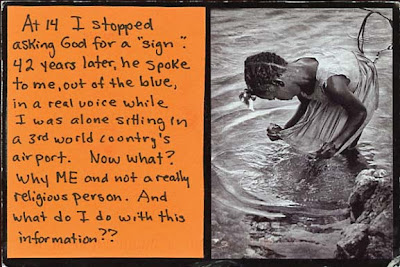
I really enjoy
PostSecret, and even listened to a recent NPR program on the site.
Specifically I really enjoyed the above postcard, and thought it was very poignant. The site is filled with, and cards are well-chosen, to give a certain honest humanity and dramatic power that it's so hard to find in the media or even interpersonally. PostSecret tells you a lot about people, even considering that I suspect half of the 'secrets' are really quite embellished.
Labels: ideas, psychology
Levels of Acceptance and Validation
Given to me by my new friend the clinical psychologist, a series of ways to build better rapport with individuals.
1. Observation/Alert/Awake
2. Rephrasing
3. Reading
4. Understandable in the context of the past, biological dysfunction
5. Validating the person in their current functioning - validation is not praise, rather, it is accurate understanding
6. Radical genuineness - treat as unique, you are real and genuine, disclosure
Labels: psychology
How to stop rumors
I thought
this was a very interesting link above my gmail today, and I appreciated the nice reverse psychology employed not only in the broadcasting of the rumor to everyone, but also in the introduction of counter-information that gives the crowd something else to chew on.
Labels: psychology
Ideas, Assumptions and Confirmation Bias
A news item today confirms what one might have already suspected (pun alert) that
people believe what they want to believe, not what is actually true. This has a few things one can infer from it which are none too pleasant: that people would rather be told what to think by established authority figures than necessarily have to go to the trouble of thinking something through themselves. An oft-quoted statistic is that the number one predictor of your political beliefs are those of your parents. Now, even though many if not most children rebel from their parents and buck their authority, they still trust their judgment enough to be the strongest former of their political opinions. Quite telling. My parents, if you're curious, are kind of a mix of philosophical principles, far from the "19th century theocrat" I've been described as.
Labels: psychology, society
Deconstructing Obama Excitement
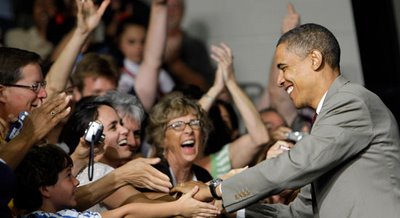
I saw this image from
this pointless IHT article about Obama's running mate. Look at the faces, they're ecstatic. I've met John McCain before, I've met my fair share of celebrities and famous people, and never, never once, has it occurred to me to be quite this excited. And so, with perhaps too much armchair psychology, we ought to say what could motivate one to be this worked up.
Clearly, the moment meeting and touching a famous person can't be this rationally exciting. Otherwise there'd be a business of paying to touch famous people. And it's really not about their fame per se, since many other politicians are famous but people don't react this way, i.e. when people meet Newt Gingrich they faint. And it's not the policies they support since academics and other politicians don't elicit this sort of response. I suspect it really has to do with two issues: media-hype coupled with a certain base sex appeal, and the excitement of later being able to brag to their friends that they met someone famous in the media. What's rare is desired, and what's current and timely is more desired so as to set ourselves as superior to our friends. A silly notion, to be sure, but I'm at a loss to explain this picture any other way.
Thinking about human dynamics and trying to extrapolate some sort of rule:
Subject
1. Must be adored by the media/whatever functions as media, i.e. gossip circle, some sort of social validation
2. Must be desired by the group and individuals within the group, some base sex appeal
3. Must be rare, not around all the time, otherwise gets taken for granted
4. Have a compelling personal story
I think this explains to some small degree why ugly men can date models, why good girls date bad ones, and perhaps how Chicago ad-men managed to make a huge swath of the country settle for a bad candidate for President.
Labels: media, obama, psychology