Buildings, Bureaucrats and Bitchy Ben
Having run across
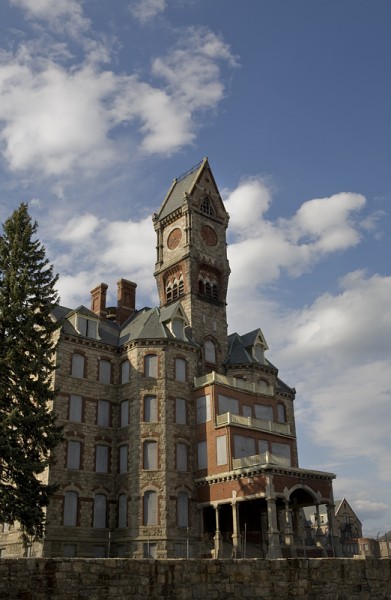
"Worcester State Hospital" online at an odd-Americana type event, I was overjoyed to easily find the creepy abandoned sanitarium from the road. As I approached, though, the street in front of it was blocked off for some silly bureaucratic reason. I drove up anyway, and saw all sorts of posted signs about no pedestrian access, no admittance, no entry and crap like that. Frankly, few things upset me more than lazy bureaucrats hanging bitchy signs telling me where I can't go. Little did I realize that I was being followed, and that I was being watched to wait and see if I would approach, no doubt ready to give me a good scolding for not obeying the clearly marked signs. Oh, let me also point out, that this is public land. It's extremely frustrating and aggravating that these bureaucrats are cordoning off entire swaths of land and declaring that you and I cannot trespass on public land. I remember the same frustration, post 9/11 when the aristocracy decided to keep the people's house away from the people, because God forbid the people actually come to it. Who am I being protected against? The easy answer is to say that they're afraid of lawsuits, but let's not forget who writes the laws! Who enforces them! The government can't tell me with a straight face that they're worried about my safety and my security and their liability when they are the ones writing the laws. I don't want to make too much about this, but I just think it's a small part of an overall trend where we are subconsciously conditioned to accept blind authority. We are told where we can go, and no one deviates. We are told what we can photograph, and no one dissents. We are told that "copyright" protects all aristocratic interests, and those who violate are defamed as 'thieves' - we tolerate this oppressive cultural control by these self-appointed bureaucrats and by a legal system gone mad. I ventilate my frustrations through writing, but it's only a temporary fix. You can't paint outside without being harassed by the police, you can't assemble without people asking for your damn permit, and you can't live outside the lines without enormous pressure to box you back in. The land of the free, home of the brave has become the land of those who comply with the bureaucrats and the few who end up fined, harassed and imprisoned for nothing more than refusing to paint by numbers.
Labels: architecture, government, regulation, resistance, society
Soviet Madness: Modernism eats the past
The Taliban were not the first to destroy religious symbols, they learned it well from the barbarian Soviets to their north. The
Cathedral of Christ the Savior was demolished to make way for the
Palace of the Soviets, a
truly hideous monstrosity, especially in
contrast to the Cathedral. What is it about modernism that requires it to destroy the past, never can it live peaceably with it. The proof of the past, perhaps speaks too loudly and too clearly for the disorders of modernism to tolerate their fine example. When Christianity overtook pagan Rome, they incorporated
the Pantheon, and
Christianized, even, the Coliseum. Where Christianity grows, develops and improves, modernism in whatever form always destroys.
Labels: architecture, art, Christianity, history
Liturgical Design Oppression
We ought to end the Protestant Occupation of our sacred Catholic places, namely in the design and architecture of our churches. Michael Rose wrote a wonderful book called "
Ugly as Sin" which I would highly recommend to anyone. It seems as though the constant theme is that Vatican II misinterpretations have given rise to liturgical anarchy.
This quote was very telling, from a liturgical design consultant Fr. Vosko, part of
this article from
Catholic Culture which is actually taken from
the Wanderer.
During his lecture, Fr. Vosko expressed his preference for the church-in-the-round model, saying circles — citing Stonehenge, Indian tepees, and mandalas as examples — are powerful symbols, as is the labyrinth. He also defended Corpus Christi Chapel's movable bare wooden cross, which he described as a "powerful totem that puts us in touch with that which can be."
He told his audience that when he is retained as a consultant for a parish renovation, that "sometimes you have to strip away things ... that get in the way, things that are just habits."
That which is being stripped away, obviously, is any tradition or Catholicism. And I was also somewhat shocked to see that Michael Rose was offering no exaggeration in his "Ugly as Sin" book that many of the Catholic design consultants are really Protestant ones as well. You can see that for yourself
here, and even the ones that tend to be more "Catholic" are still
falling short of the majesty of the house of God. The tendency to make them meeting places rather than sacred spaces seems too tempting for the designers.
I'd like to further flesh out Rose's thesis, compare some local churches which are both good and bad, and really define what I'm referring to here. Perhaps in some small way the way to a beautiful future is through future beautiful churches. And as Lauren Conner once quoted to me, "beauty will save the world."
Labels: architecture, beauty, Catholicism, Church, design, truth


